
A Choice Of High Consistency and Liquid Silicone
C & M Rubber Co. has a longstanding business relationship with many HCR Solid Silicone rubber and LR Liquid Silicone rubber suppliers, including Wacker, Momentive, Dow Corning, and Valley Rubber. Each vendor has a library of silicone compounds to draw from that will meet most if not all material specifications. Using the elastomer of your choice, C & M Rubber Co. has in-house capability to mix a silicone compound or contract with a supplier to mix the compound for your specific application. This choice is driven by monthly quantity required and locking in the most advantageous price.
Color Matching, Durometer, Temperature Resistance
C & M Rubber Co. can color match the Pantone© Formula Guide. We can also produce a custom compound with the durometer (hardness) granularity to ±5 points. With 53 years of experience, we have cataloged a wide breadth of knowledge in developing compounds that can tolerate wide ranges of temperature, tear resistance, and compression set. From one pound to fifty-pound batches, C & M Rubber Co. can recommend and mix just the right elastomeric compound for your application.
UL/NSF Certification
For applications that require qualified elastomers, C & M Rubber Co. will assist your organization in processing the required documents to apply for UL and /or NSF Certification.
C & M Rubber Co., founded in 1964, was primarily a distributor of rubber goods and related lines for a host of manufacturers including Uniroyal and Goodyear. The primary focus was stocking and reselling a large selection of standard o-rings, gaskets, hose, v-belts and conveyor belts to commercial and military installations. C & M was also heavily involved in military contracts, preparing skin-pak service kits for a variety of repair applications.
During the late 1960's and early 70's, C & M entered a new venture; custom silicone molding. Applying the knowledge and experience in successfully bidding military contracts, C & M Rubber Co. landed a significant contract to mold silicone seals for the Zuni rocket. As the military business grew efforts to branch out and serve other industries led to our current concentration in the medical, food service, aerospace and high tech fields.
Molding silicone and other elastomers is primarily a function of balancing three variables: time, temperature and pressure. Of equal importance is the quality and workmanship in creating a mold (tool) that will provide a dimensionally accurate part with the desired finish. It is for this reason that we often recommend cutting a single cavity prototype tool to confirm material suitability, shrink calculations and dimensional precision. Once satisfied that the prototype is correct, the construction of production tool follows as the next step.
Since our principal market niche is production runs of one to thousands of parts, we employ the use of either a transfer or compression mold (tool) as opposed to liquid injection molding (LIM). The overriding factor in this choice of tooling format is cost. With prototyping or "limited" production runs, customers are rarely willing to commit to a high initial capital cost for tooling. Thus, transfer or compression molds (tools) offer one of the most cost-effective ways to produce more limited numbers of parts.
So which format would be best for my application?
Depending upon the geometry of the part, the elastomer being used, the target component cost and a host of other molding considerations will determine which design we recommend.
What about cost?
Typically, one of the first questions asked by novice and experienced component design engineers is how much will the tooling cost and what is the piece price? Frankly, without thoroughly reviewing your drawing, evaluating the design complexities, the required dimensional tolerances, and the estimated annual purchase requirement, our response would be inadequate upon which to make a decision.
So what is the first step?
Our engineering consultants are willing and able to recommend and quote the most cost-effective tool and piece price for your specific project. To learn more, request a quote from our team today.
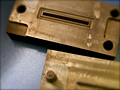
Some of the finest toolmakers in the country are located in Dayton, Ohio. For 53 years, C & M Rubber Co. has worked with many toolmakers to produce high quality and durable tooling. The tools range from a simple o-rings to parts consisting of sophisticated, geometrical curves with challenging dimensional tolerances. Ultimately, our customers enjoy the benefit of our years of tooling and molding experience by incorporating our proprietary know-how into their tooling. These unique techniques contribute to a dimensionally true part that costs less to mold and process into a finished part. The best news is we can accomplish all of this within budget and on time.
Prototype Lead Time
As a general rule, discounting cueing delays as a result of heavy job scheduling demand and depending upon geometric complexity, a single cavity prototype can be completed in as few as 15 days. To minimize delivery disappointment, it is recommended that a date is established prior to “cutting steel”.
Production Tool Lead Time
As a general rule, it is recommended that you allow at least 75 days and sometimes 90 days for production tool completion. If you are looking at constructing a liquid injection mold, lead times can range from 90 to 120 days due to the tight tolerances required for successful tool performance.
There are many factors that affect tooling delivery, including:
The geometric complexity of the molded part is a prominent factor in the lead-time required to complete a mold (tool). Some molded shapes require complex, multi-stage cutting and the use of sophisticated CNC machines to create the finished product.
The higher the cavity count, the longer it will take to complete a mold.
The closer the dimensional tolerances, the longer the lead-time will be.
Dimensional changes processed after steel cutting has commenced will extend the lead-time and may require abandoning the current tooling project and starting over.
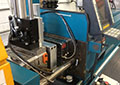
At C & M Rubber, we are an industry leader in the area of rubber injection molding. Rubber injection molding is a very efficient method for manufacturing custom rubber products, most notably in higher production volumes. With our history in the rubber manufacturing industry dating back to 1964, we have the knowledge and experience to identify when rubber injection molding is the best option based on part geometry, elastomer being used, target unit cost, and other considerations.
Our specialty is in liquid injection molding micro-sized, miniature, and small rubber components. We find it advantageous to work with customers early on in the project to review designs for moldability and understand the service conditions to recommend an elastomer. Along with an extensive selection of standard silicone compounds, we can custom mix an elastomer with an application-specific durometer, temperature resistance, and color, including Pantone® match. We also assist with document preparation for UL/NSF certifications if necessary.
Our typical scenario involves building a single-cavity prototype tool to validate material selection, shrinkage allowance, dimensional precision, etc. When the prototype is approved, we build production tooling with up to 144 cavities. Our facility houses presses rated from 15 tons to 450 tons, and we monitor time, temperature, pressure, and other process variables to ensure process stability and product quality and consistency.
We manufacture a wide variety of rubber components, from ultra-high-speed print heads and small surgical tool components to simple gaskets and seals. Our rubber injection molding services are certified to ISO 9001:2015 standards, and we serve customers in the military, food service, medical, aerospace, and high-tech industries. For more information about our company and our liquid injection molding capabilities, contact us directly.
